Romzai Verified Livability Rating™ — Frequently Asked Questions
“Hi, I’m Kitmanut, Founder of ROMZAI — The Livability Institute.
We provide independent livability due diligence for residential projects — verifying how a building will perform under real occupancy.
We focus on what we call the Livability Gap, which is often where buyer hesitation happens.
By making that visible, we help developers improve transfer certainty and protect long-term value.”
🧠 1. “How is this different from what we already do?”
“Most current processes validate design and construction quality.
ROMZAI verifies how the building will actually perform when people live in it.
We focus on the gap between intention and lived reality—that’s where most issues emerge.
💰 2. “How does this impact our revenue?”
“We reduce buyer hesitation at the point of decision.
When livability is independently verified, buyers commit faster and with greater confidence—especially in higher-value segments.
🧱 3. “Is this overlapping with architects or consultants?”
“No—we don’t design or advise on design.
We operate independently to verify performance.
That independence is what gives our rating credibility in the market.”
⚖️ 4. “What if the rating is not strong?”
“Our rating is not static—it’s dynamic.
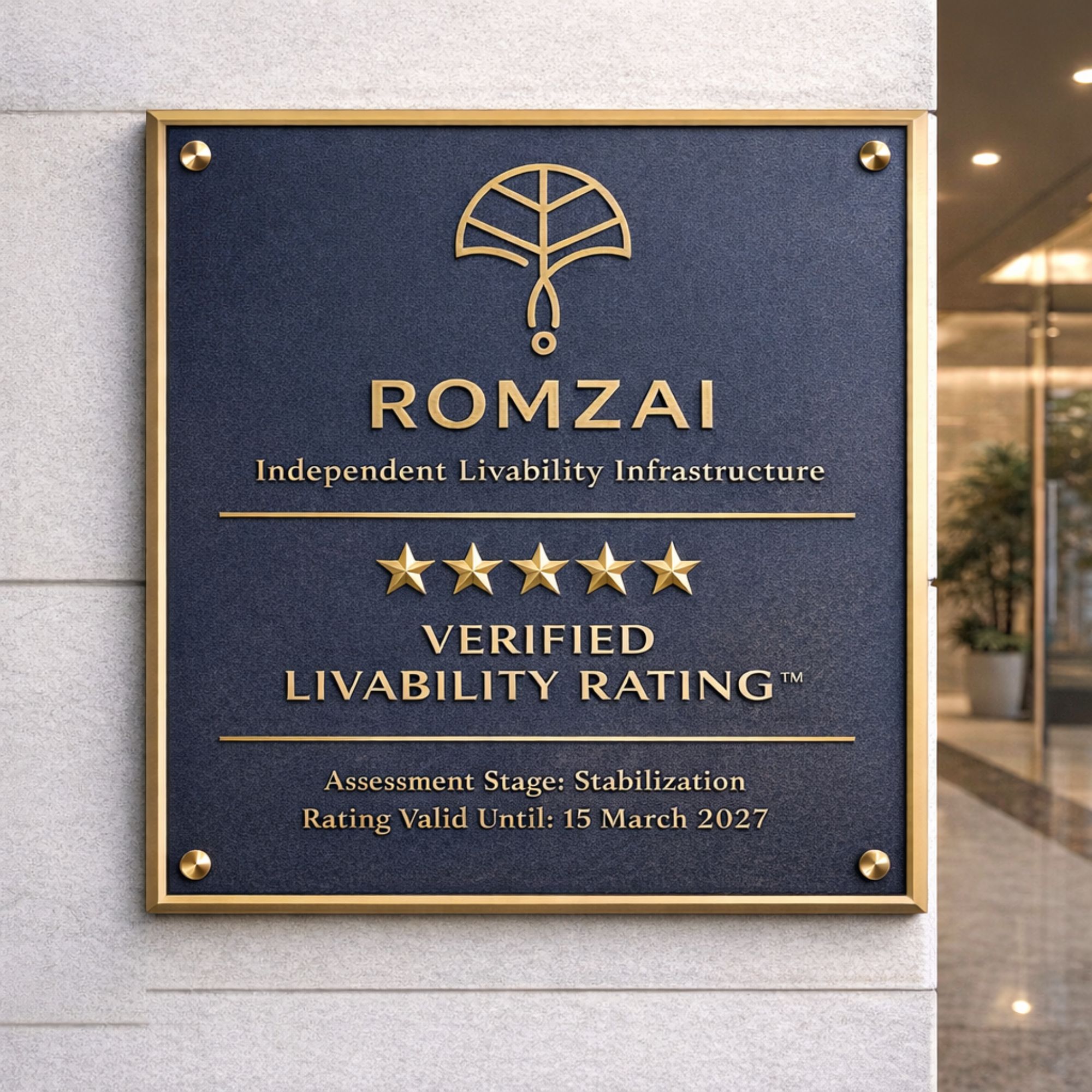
Livability performance evolves once a building is in operation.That’s why we apply a 180-day revalidation discipline.
Ratings can adjust based on real conditions—whether performance improves or gaps emerge.So a rating is not a one-time judgment.
It’s an ongoing verification of how the building actually performs over time.”“The rating evolves with the building.”
🕒 5. “When should we engage ROMZAI?”
“The earlier, the more strategic.
At development stage, we provide forward visibility.
At stabilization, we validate real performance.
Across lifecycle, we ensure alignment from sale to stay.”
📊 6. “Is this a certification or a rating?”
“It’s a rating system.
We don’t certify compliance—we verify performance.
That distinction is important because it reflects real-world conditions, not just standards met.”
🧩 7. “What exactly are you measuring?”
“We assess structural conditions—space, environment, density, governance—
and interpret how they translate into lived experience: comfort, recovery, and daily ease.”
💼 8. “How do we explain this to buyers?”
“Very simply:
this project has been independently verified for how it will perform when you actually live in it.
That clarity builds trust immediately.”
🏁 9. “What’s the end outcome for us?”
“Alignment.
Between what you promise, what you deliver, and what residents experience.
That’s what ultimately protects both sales performance and long-term brand value.”